
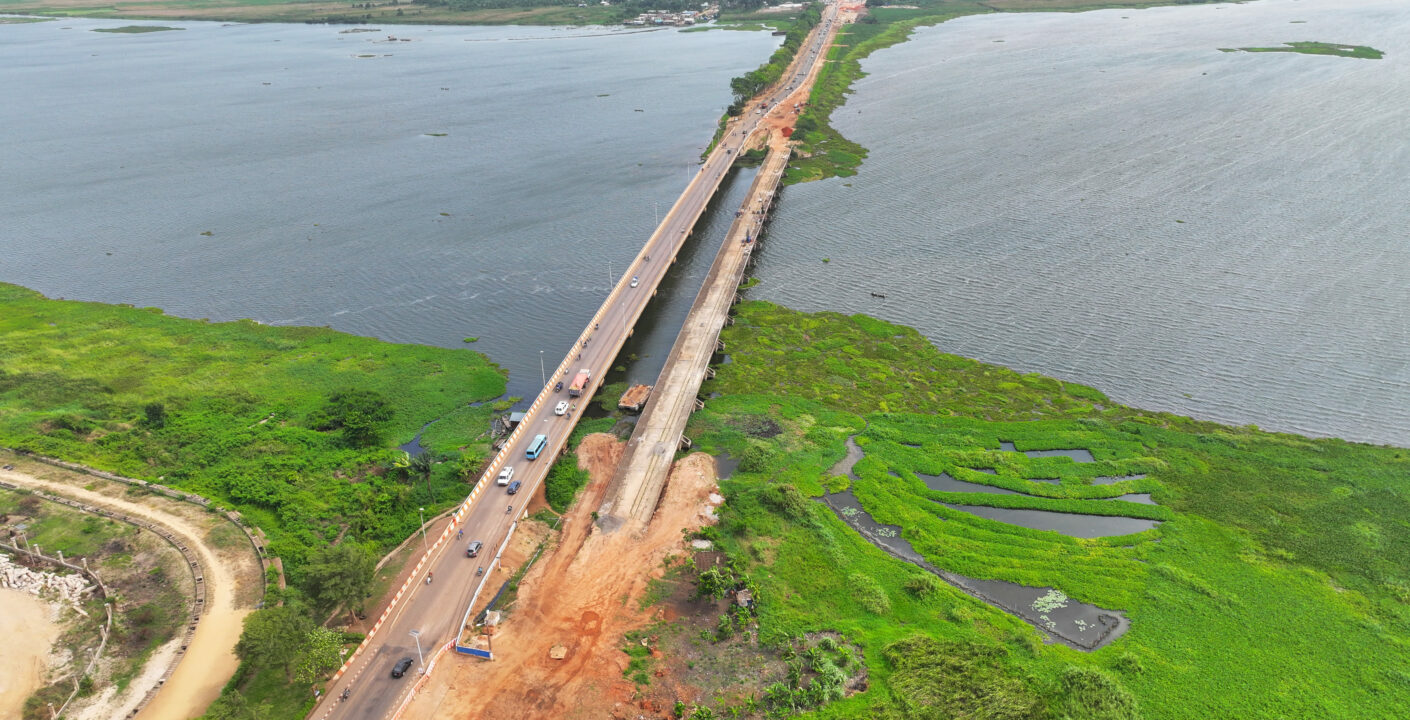
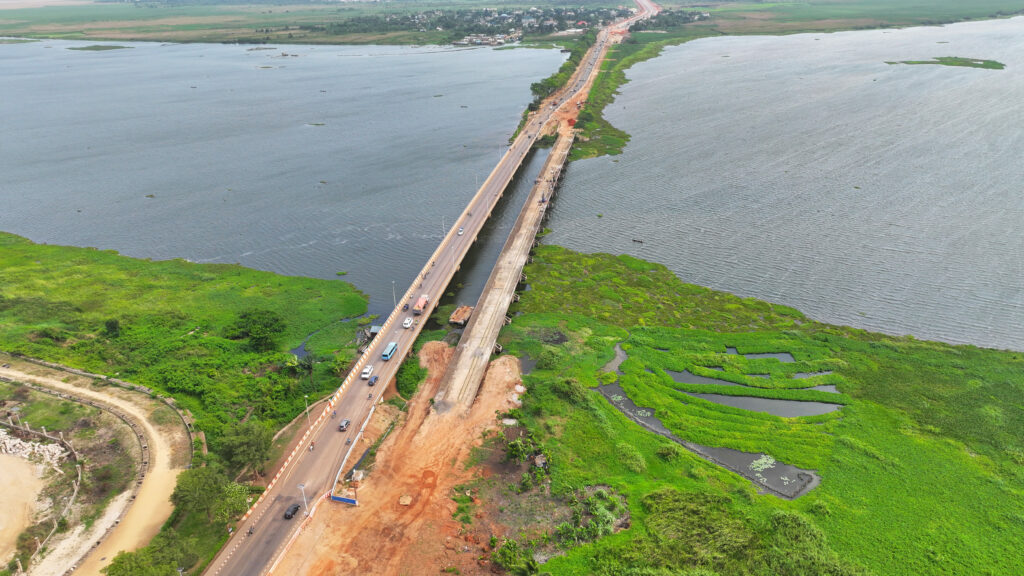
Every day, the 10 km between the Sèmè junction and the Porto-Novo Bridge turn into a nightmare: an hour on the road to cover a trivial distance. The dual carriageway linking the Sèmè junction to the new Porto-Novo bridge, both delivered by PORTEO BTP, will change the game. The goal: cut travel time to 15 minutes and, above all, free up the lagoon for modern river transport, a key to the economic and tourism development of Benin’s political capital.
A bottleneck turned into an opportunity
The current bridge is too low and restricts navigation on the lagoon. Yet according to the Greater Nokoué Sustainable Urban Mobility Plan (PMUD-GN), a network of water buses carrying up to 8 million passengers a year by 2030 is planned on the Cotonou–Porto-Novo route. As long as the crossing remained blocked, this potential stayed theoretical. The new bridge, designed with an arch that provides enough clearance, unlocks the situation: it allows cargo and passenger boats to pass, paving the way for a new blue economy.
“With optimal clearance over the lagoon, the bridge becomes a catalyst. It releases river potential that had been stifled and finally connects Porto-Novo to a regional dynamic of trade and tourism,” explains a PORTEO BTP engineer involved in the project.
Measurable economic gains
The impact can be quantified: today, traffic jams between Cotonou and Porto-Novo cost an estimated €21 million a year in lost productivity and fuel. Once in service, the bridge will reduce this cost by freeing up nearly 29,000 hours of travel time per day, the equivalent of several thousand working days.
But beyond the road, it is the lagoon that opens up. With a river transport network, port trade and tourism are set for a decisive boost. The African Development Bank (2023) estimates that modern river infrastructure can increase regional trade flows by 15 to 20%, while halving the carbon footprint of transport compared with road.
Tourism and the blue economy in sight
Porto-Novo has a unique cultural and natural heritage, often overshadowed by the energy of Cotonou. By allowing tourist and commercial navigation, the bridge redraws the map. Water buses for city dwellers, but also river cruises and eco-tourism circuits, will showcase the lagoon.
According to the World Tourism Organization (UNWTO, 2023), river tourism is a fast-growing segment capable of generating up to 25% additional revenue for riverside cities. With a structured river network, Porto-Novo could become a must-visit stop for lagoon tourism in West Africa.
A project at the heart of PORTEO’s vision
For PORTEO Group, this bridge illustrates its strategy: building infrastructure that does more than link two points on a map, and instead creates integrated value chains. Already active in roads, quarries and materials industries, the Group demonstrates here its role as an African champion of sovereignty.
“Building a bridge is more than pouring concrete and steel. It means creating a link between communities, turning constraints into opportunities and placing Benin within a regional dynamic,” says Hassan Dakhlallah, founder of PORTEO Group.
An emerging logistics and tourism hub
In the long run, the Porto-Novo bridge goes beyond its role as a road crossing. It becomes a pivotal piece of infrastructure:
- for logistics, by easing trade between the port of Cotonou and hinterland countries (Niger, Burkina Faso);
- for tourism, by opening a new cultural and natural showcase;
- for urban mobility, by integrating Porto-Novo into the future Greater Nokoué water bus network.
Economic projections confirm the project’s viability: an internal rate of return (IRR) estimated at 10% and a payback period of 4 years, thanks to time savings and the expected growth in river traffic.
The Porto-Novo bridge’s key figures
- Travel time cut: 60 min → 15 min.
- Projected river transport: 8 million passengers/year by 2030 (PMUD-GN).
- Current losses due to traffic jams: ≈ €21M per year.
- Projected return: IRR 10%, payback 4 years.
- Effect on regional trade: +15 to 20% in trade flows (AfDB, 2023).
By opening up lagoon navigation and easing mobility, the Porto-Novo bridge embodies a profound transformation: it connects people, stimulates trade, attracts tourism and positions Benin as a major logistics player in West Africa. For PORTEO Group, it is much more than a construction project: it is a vision of industrial sovereignty and regional integration taking shape, a bridge between the local and the continental.